
AFI-Uplift Limited (‘AFI’) is the largest UK employer within the AFI Rentals Group and is the only group company with more than 250 employees.
AFI’s board of directors recognises that our business success comes not only from strong financial performance, but also from carefully fulfilling our responsibilities to society.
The particular commitment we make to our workforce is reflected in AFI’s core principles which consistently acknowledge the AFI team as our greatest asset. In return we ensure that our employees are treated equally, are fairly rewarded, and work in an inclusive, supportive and enjoyable workplace.
Under the Equality Act 2010 (Gender Pay Gap Information) Regulations 2017 (the ‘Regulations’), all organisations with more than 250 employees are required to publish information on pay and gender, to improve the transparency of differences in pay between men and women. The ultimate aim of this reporting is eradicating gender inequality.
As required by the Regulations, the analysis and commentary in this report covers the following six measures:
This report reflects actual data of members of staff employed by AFI on 5th April 2025 (the ‘2025 Snapshot Date’). At this date, the workforce covered by the Regulations consisted of 255 men and 47 women.
As is the case for many other businesses, overall gender pay statistics can be distorted by differences in the mix of men and women at different levels of the organisation, and particularly the disproportionate impact of senior employees such as company directors. We have therefore also presented data excluding directors where we believe it is relevant to how the data is interpreted.
The plant hire industry in which we operate has historically attracted more male than female applicants, and this can be seen in the higher proportion of men than women in AFI’s workforce today. We recognise, however, that we must take responsibility for driving continued change in this dynamic alongside our industry peers. AFI continues to commit to impartial recruitment processes, investment in the training and development of our team, the availability of flexible ways of working, and the provision of a wide range of employee benefits and wellbeing schemes which are attractive to both male and female employees.
We appreciate that ongoing action is required and we will continue to seek out opportunities to improve balance within our workforce
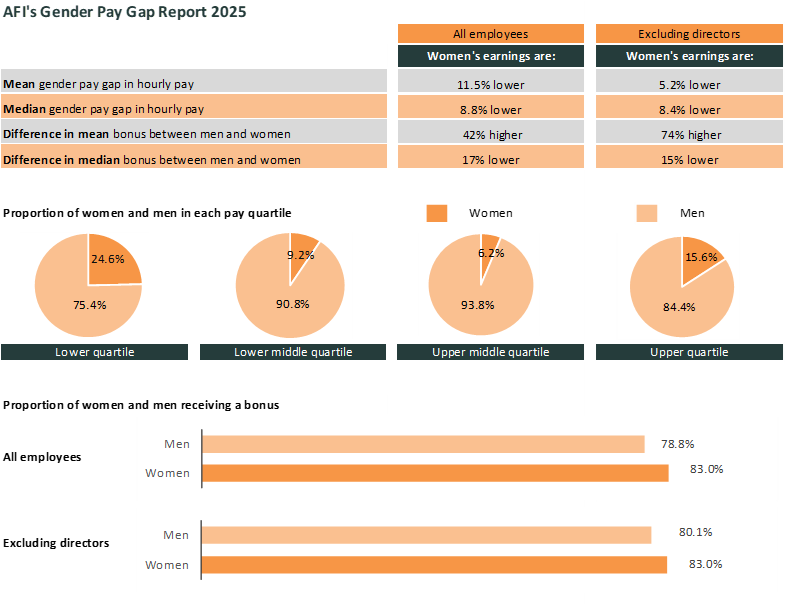
Review of Gender Pay Data
AFI’s mean pay gap fell further from 11.9% in 2024 to 11.5% in 2025. Excluding directors, the mean gap was even narrower at 5.2%, albeit this measure had increased a little from 2.1% in 2024.
AFI’s median pay gap saw an even more marked reduction from 15.8% in 2024 to 8.8% in 2025 (8.4% when directors are excluded). These are the lowest levels of reported gap since gender pay gap reporting commenced in 2017 (excluding the 2020 and 2021 gender pay gap reports where data was heavily distorted by the impact of the COVID pandemic on working patterns).
Given the relatively small population of female members of our business, average data can be susceptible to year-on-year volatility, caused by relatively small changes in the mix of employees. Regardless, it is pleasing to see a reduction this year.
Most fundamentally, we remain confident that no bias exists in AFI where men and women undertake the same role in the same part of the country, and any reported gap purely reflects the weighting of gender across different roles within our business. Specifically higher-paid roles, which are particularly site-based in nature such as engineers, plant operators and HGV drivers, are traditionally dominated by male workers.
We welcome female applicants for any role in the business, but we also appreciate that we must continue to make all positions, including these site-based roles, equally as attractive to all.
In addition to the structured apprenticeship programmes and inclusive recruitment and employment practices we already offer, this will require continued elevation of positive female role models across our business and increased collaboration with schools and colleges to improve female applicants’ perception of the industry over time.
AFI is committed to providing an attractive reward package and in the 12 months ended 5th April 2025 approximately 80% of employees received a bonus, paid across a number of different incentive schemes. These schemes had differing frequencies of pay and varying qualification criteria, reflective of the wide variety of roles in our business, and this can again distort the data.
The mean bonus paid to women was 42.2% higher than that paid to men (74.4% higher excluding directors). Furthermore, a larger proportion of women than men earnt a bonus during the review period.
We acknowledge that our industry has faced a long-term challenge of attracting more male than female applicants to roles; which weights levels of sector experience and therefore financial reward towards men. This is reflected in AFI’s own director group, which continues to comprise more men than women, in turn distorting AFI’s reported pay gap.
Although it can take a number of years to correct a historical gender imbalance within any industry, AFI recognises the value of diversity in our workforce and the important role our business must play in changing this over time. We are committed to equal opportunities for employment, reward and progression for all members of our team, regardless of gender.
I confirm that the information within this report is accurate.
Paul Roberts, Group Chief Financial Officer
24th March 2026